
What Is SEO in 2026? Complete Guide to Search Engine Optimization
Blog
July 20, 2026
211 views
Super Admin
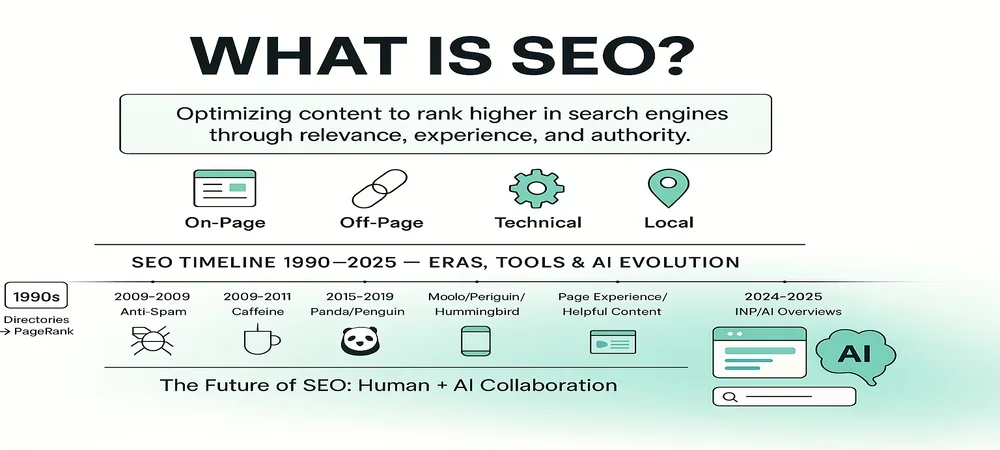
Search Engine Optimization (SEO) in 2026 is about creating high-quality, user-focused content while optimizing your website for search engines, AI-powered search experiences, and evolving ranking algorithms. From keyword research and technical SEO to content optimization and link building, a strong SEO strategy helps increase visibility, drive organic traffic, and grow your business online. This complete guide explains how SEO works in 2026, the latest best practices, and the key strategies for achieving long-term search success.
SEO helps people find you without ads. It connects real searches to clear answers on fast, trustworthy pages. In this guide, you’ll learn what SEO is, how search works end-to-end, and what actually moves results in 2026.
We start with the basics: crawl → render → index → rank. Then we explain SEO vs SEM/PPC so you can pick the right mix for speed, cost, and ROI. Each section stays answer-first with steps, tables, and quick checklists you can use today.
Next, we map the full timeline of SEO—from the 1990s to 2026—with real dates, updates, and what teams did next. You'll see timeline tables that show how SEO changed over the years — from early search updates to the new AI era with tools like MUM and SGE. You’ll also learn how INP replaced FID and why Google now lowers ranks for copied or low-quality content.
You’ll learn the three main parts of SEO — On-Page, Off-Page, and Technical — explained in simple words. Then you'll see how they connect to site speed, trust, and user experience (CWV & E-E-A-T). We'll also cover local, international, and online store SEO, plus what mistakes to avoid. Real examples will show which changes made real results, so every fix has proof.
By the end, you’ll know what to fix first, how to structure pages for features, and how to measure non-brand clicks, share of voice, and conversions.
Key Takeaways:
Fix the basics first. Make sure your pages can be found and indexed before worrying about rankings.
Write to answer. Start with the main question users ask, then explain it with simple steps, examples, or short tables.
Show you can be trusted. Add author names, reviews, real photos, and clear policies so people know who's behind the site.
Keep your site fast and stable. Pages that load quickly and don't jump around keep visitors happy and help rankings.
Connect your pages. Link related topics together so search engines see your site as one strong, helpful network.
Earn mentions the right way. Get links from real news, blogs, and experts—not from spammy sites or fake exchanges.
Measure what matters. Look at traffic, leads, and sales—not just keywords or clicks.
Be ready for the future. Google is using more AI. Create content that's helpful, original, and ready to be shown in AI Overviews.
What Is SEO?
SEO, or Search Engine Optimization, means making your website easy for Google and other search engines to find and understand. It helps your pages show up for the right people at the right time. That's why SEO is important for any business that wants long-term visibility without paying for ads.
Search engines index billions of pages. SEO helps your site stand out by answering what people actually search for. Organic results differ from ads: clicks are earned, not bought. The goal is long-term visibility, not temporary boosts.
In essence, SEO connects the dots between user intent, content relevance, and technical excellence. To understand how SEO delivers lasting results, it helps to look at its foundation — the core pillars that define every successful strategy.
The Three Pillars of SEO
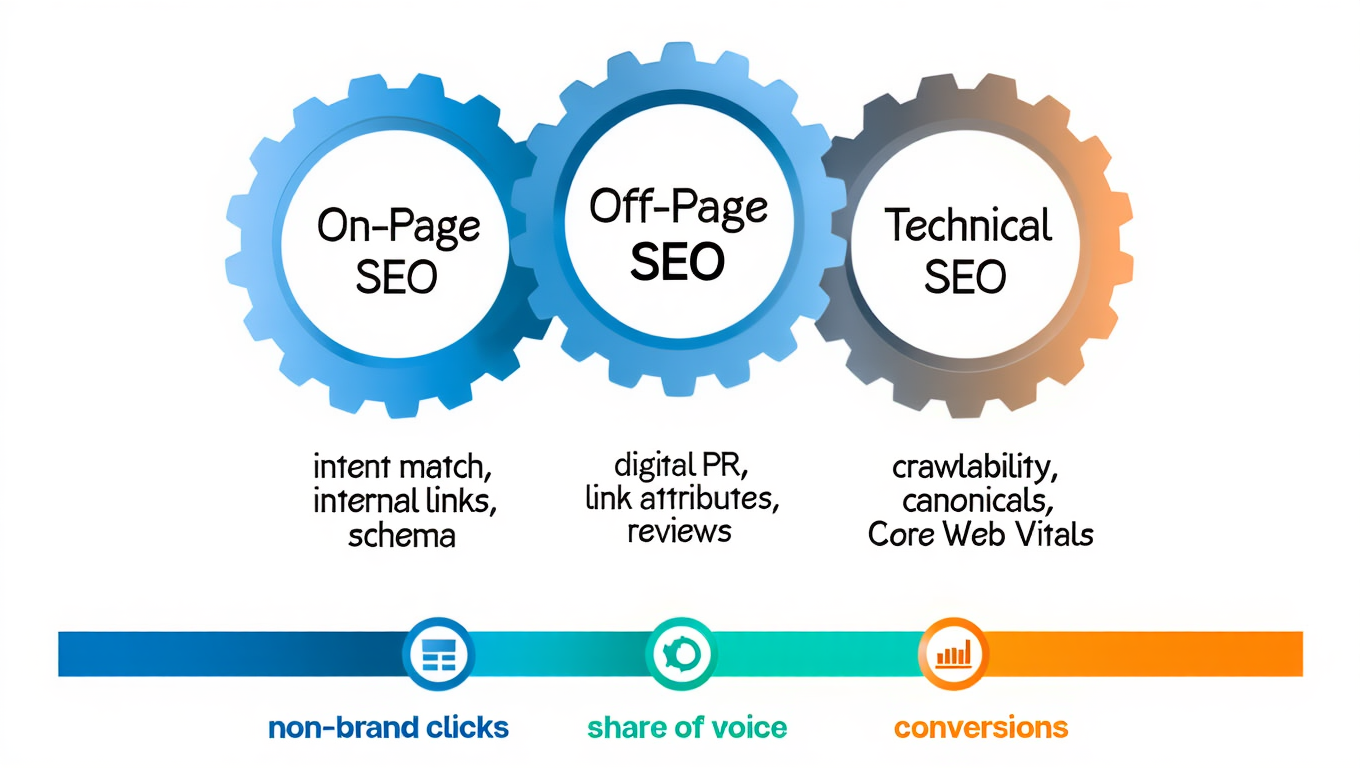
Every SEO strategy balances key elements, often called “pillars” that are On-Page (what you say), Off-Page (what others say), and Technical SEO (how it’s delivered). These pillars ensure your website isn’t just discoverable but also trusted and useful to search engines and users alike. They work like gears—weakness in one slows the others. Plan, fix, and measure across all three.
Pillar Checklist (Priority Stacked)
Item | Why It Matters | Tool / Report | Owner | ETA |
Titles & Headings | Define hierarchy & relevance | GSC | Content Team | Ongoing |
Schema Markup | Enables rich results | Validator | SEO Lead | Monthly |
Core Web Vitals | UX ranking signal | PSI / CrUX | Dev Team | Sprint |
Backlink Quality | Authority & trust | Ahrefs / Semrush | PR Team | Quarterly |
Internal Links | Topical context | Screaming Frog | SEO | Monthly |
On-Page SEO — Say It Clear, Keep It Simple
On-page SEO is about clarity, structure, and purpose. Each page should answer a user’s question fast — in 40–50 words — then expand naturally into related insights. Use clear titles, short headings, and internal links that guide both users and search engines through connected ideas. Add schema markup (FAQ, HowTo, Product, or Article) to qualify for rich results and featured snippets.
Best Practices:
Place a direct 40–50-word summary under each key question.
Use lists for steps and tables for comparisons.
Highlight short definitions in “definition boxes” right below H2 or H3 headings.
Keep sentences simple and active for featured snippet readability.
Together, these design and writing conventions make your content easier to index, understand, and quote across AI Overviews and search surfaces.
Off-Page SEO — Build Real Trust
Off-page SEO builds your site’s credibility and reputation through what others say about you — mentions, links, reviews, and media coverage. The goal isn’t collecting backlinks; it’s earning recognition from credible sources that confirm your expertise.
Sustainable Authority Tactics:
Publish Original Insights: Surveys, case studies, and benchmarks attract organic citations.
Collaborate with Experts: Co-author content with verified professionals to strengthen E-E-A-T signals.
Earn Editorial Coverage: Focus on PR placements, interviews, and round-ups — not link buying.
Label Links Clearly: Use sponsored or UGC attributes to stay transparent.
Monitor Brand Mentions: Track via Ahrefs or Brand24 and engage naturally, adding context, not link requests.
Off-Page & PR Risk Matrix
Tactic | Safe | Effort | Payoff | Red Flags |
Editorial PR Links | ✅ | High | Trust + Authority | — |
Expert Round-ups | ✅ | Medium | Brand Credibility | Thin content |
Guest Posts | ⚠️ | Medium | Referral Traffic | Overused anchors |
Link Exchanges | ❌ | Low | Short-term | Spam Risk |
Paid Links / PBNs | ❌ | Medium | None | Manual Penalty |
Strong off-page signals demonstrate trustworthiness and reputation — two of Google’s strongest ranking indicators for brands.
Technical SEO — Fix What Blocks Growth
Technical SEO ensures your site runs efficiently so content can actually rank. Before optimizing, confirm that pages are crawlable, indexable, and fast enough for users to interact smoothly.
Technical SEO Triage
Tackle issues in this order:
Eligibility: Check robots.txt, noindex tags, and canonicals.
Crawlability: Resolve traps caused by URL parameters or filters.
Render & Speed: Eliminate heavy scripts and unused CSS.
Page Experience & Core Web Vitals
Fast, stable, and responsive pages lead to higher engagement, conversion, and rankings. Track and improve performance across key metrics:
Metric | Target | How to Improve |
INP (Interaction to Next Paint) | <200 ms | Limit long tasks and heavy scripts |
LCP (Largest Contentful Paint) | <2.5 s | Prioritize hero media, use lazy loading |
CLS (Cumulative Layout Shift) | <0.1 | Fix element sizes, preload fonts |
Quick Wins:
Add priority hints and preconnects for critical resources.
Enable bfcache readiness for instant back navigations.
Use modern image formats (WebP, AVIF).
When all three move together, your site becomes both human-friendly and algorithm-proof — ready to rank in Google and AI Overviews alike.
Types of SEO for Different Goals
SEO is not one-size-fits-all — different strategies work for different goals and platforms.
Here’s how the main types of SEO come together to improve your website’s visibility, credibility, and conversions.
Local SEO (Maps, Profiles, Reviews)
Local SEO helps people near you find your business on maps and in “near me” or location searches. Keep your Google Business Profile complete with business details, company overview, add photos, working hours, address, and the right contact information.
Reply to reviews and ensure your company details are the same everywhere. Track calls, direction clicks, and visits — these show real results.
Local SEO Checklist:
Task | Why It Matters | Tool | Frequency |
Complete GBP | Map visibility | GBP | Quarterly |
Add Photos & Reviews | Engagement + trust | GBP | Monthly |
Maintain NAP | Ranking factor | Listings | Quarterly |
Respond to Reviews | Reputation | GBP Dash | Weekly |
Use UTM Links | Track calls | GA4 | Always |
Add Local Schema | Context | Schema Gen | Monthly |
Here’s How It Worked: A real estate company in Dubai wanted more people to find it online. They improved their Google Business Profile by adding service details in both Arabic and English, uploading fresh local photos, and keeping contact info up to date.
Within two months, their listing appeared in the top three results for “real estate agency near me,” and calls from Google Maps grew by about 46%.
Learn more in our What is Google My Business Optimization? to keep your profile complete, trusted, and visible in local searches.
International SEO (Serve the Right Market)
International SEO ensures that people can access your website in their preferred language. Use hreflang tags so Google knows which version to show in each country. Choose simple URL folders like /ae/ or /uk/, and don’t force redirects. Adapt words, images, and prices to match each country’s culture, preferences, and regulations.
International SEO QA Chart
Check | What to Verify | Tool | Fix Path |
Hreflang Pairs | Reciprocal mapping | GSC | Update tags |
Currency | Localized prices | CMS | Locale rules |
RTL Design | Direction + font | Browser | CSS adjust |
Language Switch | Manual toggle | QA | Add selector |
Meta Localization | Correct titles | Screaming Frog | Update meta |
Implementation Notes
Add hreflang sitemap for easy validation.
Use Geo-Targeting in GSC only when relevant.
Automate checks to confirm reciprocal hreflang tags.
For RTL languages (Arabic, Hebrew), test form alignment, numerals, and fonts.
Here’s How It Worked: A UAE-based fashion brand added Arabic hreflang tags and regional prices. Bounce rate dropped 23%; organic sales increased by↑ 31%.
E-Commerce SEO (Scale Without Crawl Chaos)
Online stores do better when search engines can easily read their pages. Make each category page clear and helpful, not a list of products. Use one main link for each product to avoid repeats. Keep your stock updated, and only let Google see filters that add value.
E-Commerce Optimization Table:
Element | Best Practice | Why It Matters | KPI |
Intro Copy | 50–100 words | Topical context | Time |
Filter Schema | FAQ / HowTo | Long-tail reach | CTR |
Canonical URLs | Single version | Prevent dupes | Index |
Internal Links | To top guides | Cluster strength | Traffic |
Stock Schema | Show availability | Builds trust | CVR |
SEO vs AEO vs Generative Engine Optimization
As search evolves, SEO is no longer just about ranking higher on Google — it’s about being understood and recommended by search and AI systems. This shift has given rise to two newer concepts: Answer Engine Optimization (AEO) and Generative Engine Optimization (GEO). Together, they represent how search visibility is changing in the age of AI.
1. SEO (Search Engine Optimization)
Search Engine Optimization (SEO) is the foundation of online visibility. It’s the process of improving a website’s content, structure, and authority so that search engines like Google or Bing can easily find, understand, and rank it.
Core focus areas:
Keywords and intent: Matching what people are searching for with what your content offers.
Content quality: Providing complete, trustworthy, and easy-to-read information.
Technical SEO: Ensuring pages load fast, are mobile-friendly, and easy for crawlers to navigate.
Backlinks and authority: Earning trust signals from other reputable websites.
In short, SEO helps people find your brand through search engines — by aligning your content with both user needs and search engine algorithms.
2. AEO (Answer Engine Optimization)
Answer Engine Optimization is a more focused version of SEO that targets answer engines — like Google’s featured snippets, Bing Copilot, or voice assistants such as Siri and Alexa.
Key strategies:
Write in a question-and-answer format to match how people ask.
Use structured data (schema markup) so search engines understand your content contextually.
Keep answers clear, concise, and factual — ideal for featured snippets or voice results.
Focus on zero-click searches, where users get answers directly on the results page.
AEO matters because more searches today end without a click. Optimizing for quick, accurate answers helps your brand stay visible even when users don’t visit your website directly.
3. GEO (Generative Engine Optimization)
With AI-driven search tools like Google AI Overview, ChatGPT, Gemini, and Perplexity, the next evolution is Generative Engine Optimization (GEO). It makes your content recognizable, quotable, and trustworthy enough to be included in AI-generated summaries and answers.
Key strategies:
Create factually accurate, verifiable content backed by credible references.
Build topical authority through consistent coverage of your niche.
Use semantic SEO — related terms, entities, and natural context — to help AI models understand relationships.
Maintain a neutral, educational tone that fits conversational AI outputs.
Optimize multimodal elements (text, visuals, data) for models that use multiple content types.
In other words, GEO ensures your content becomes part of the information AI engines rely on to form answers — not just something they reference passively.
In a Nutshell:
SEO builds discoverability on traditional search engines.
AEO improves visibility in direct answers and voice results.
GEO positions your brand in AI-generated responses and summaries.
These three approaches don’t replace each other — they work together.
Strong SEO gives you a solid foundation, AEO makes your content more “answerable,” and GEO prepares it for the future of AI-driven discovery.
To understand how SEO evolved into these newer forms, let’s look back at how search engines themselves have changed — from early directories to today’s AI-powered search era.
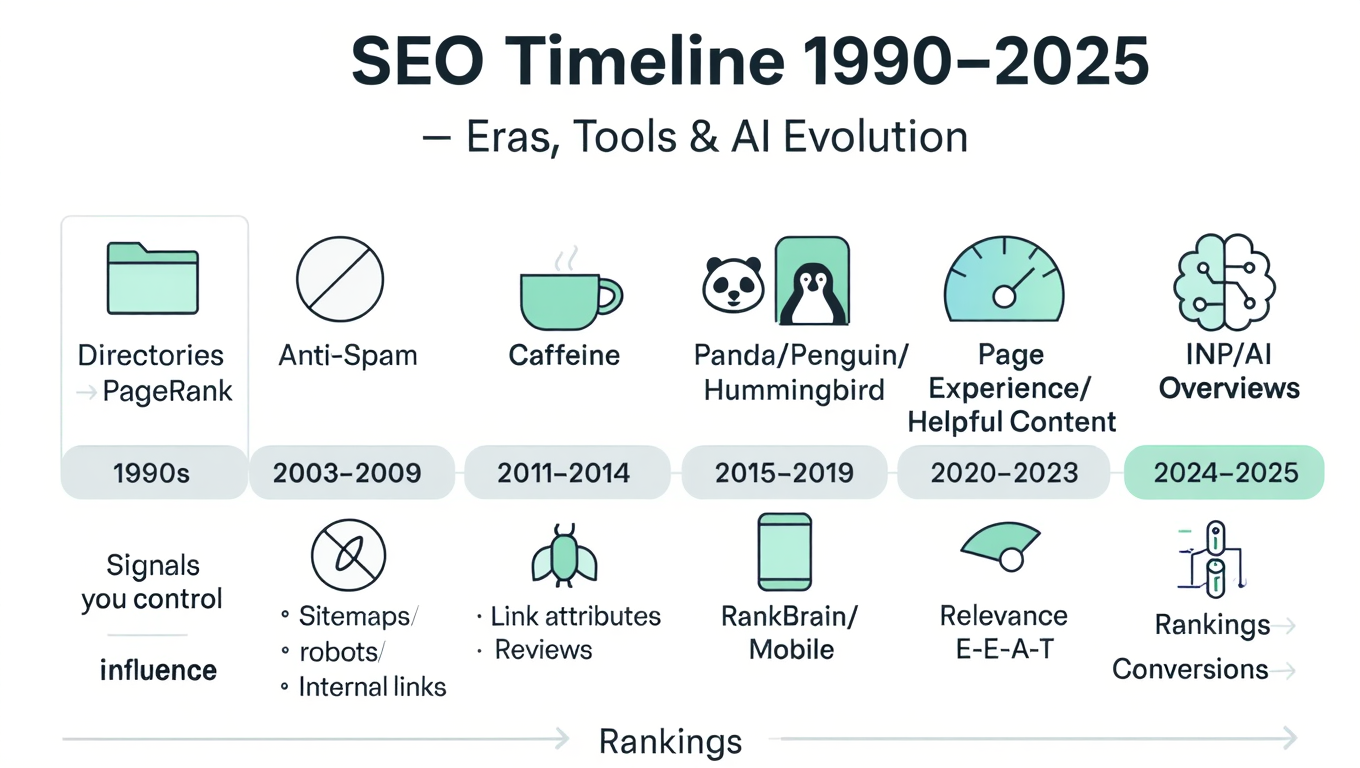
The Evolution of SEO (1990s–2026)
1990–2002 | From Directories to PageRank
Highlight: The era of discovery and trust signals.
Key Moments: Archie (1990) · Yahoo! Directory (1994) · Google Launch (1998)
Innovation: Google’s PageRank treated links as “votes of trust.”
Tools: Log files · Early crawlers · Keyword counters
Trend: Links = credibility; crawl-based indexing begins.
Insight: By 1999, Google handled 3M searches/day, up 300% YoY.
(Search Engine Journal, 2024; TheeDigital, 2023)
2003–2009 | Early Signals & Spam Cleanup
Highlight: Google cleans house; relevance beats manipulation.
Key Moments: Florida Update (2003) · Nofollow Tag (2005) · Caffeine groundwork (2009)
Tools: Webmaster Tools · XML sitemaps · Analytics
Trend: Clean architecture + genuine links > link farms.
Insight: Florida Update impacted 38% of sites, ending black-hat dominance.
(Search Engine Land, 2023; Impression Digital, 2024)
2009–2011 | Speed & Freshness
Highlight: Google gets faster and more dynamic.
Key Moments: Caffeine Update (2009–2010)
Tools: PageSpeed · Ping-o-Matic · XML Sitemaps
Trend: Speed, crawlability, and frequent updates = visibility.
(SEJ, 2024; Landingi, 2023)
2011–2014 | Quality & Webspam Enforcement
Highlight: Content quality becomes the heart of SEO.
Key Moments: Panda (2011) · Penguin (2012) · Hummingbird (2013)
Tools: Disavow Tool · Screaming Frog · Ahrefs · Semrush
Trend: Thin content dies; original, intent-driven content wins.
Insight: Panda cut thin-content share by 12%, boosting in-depth guides.
(Yoast, 2024; Search Engine Land, 2023)
2015–2019 | Mobile-First & Machine Learning
Highlight: SEO goes mobile and AI joins the game.
Key Moments: Mobile-Friendly Update (2015) · RankBrain (2015) · HTTPS push (2014–16) · Medic Update (2018)
Tools: Lighthouse · GSC · PageSpeed Insights · Schema testers
Trend: Search intent, structured data, and security shape ranking.
Insight: By 2018, 52% of traffic was mobile.
(Semrush, 2024; Ahrefs, 2024)
2020–2023 | Page Experience & Helpful Content
Highlight: Google rewards real expertise and better UX.
Key moments: Page Experience (2021–22) · Helpful Content (2022–23) · FAQ/HowTo reduction (2023)
Tools: CrUX · Lighthouse · Schema Validators
Trend: UX metrics (LCP, CLS, INP) define success.
Insight: People-first pages saw +17% engagement post-update.
(Search Engine Land, 2023; ROI Revolution, 2024; Yoast, 2024)
2024–2026 | AI, Speed & Source Credibility
Highlight: The AI era reshapes SEO visibility.
Key Moments: INP Update (2024) · Core/Spam Updates (2026) · AI Overviews (2026)
Tools: GSC (Discussions filter) · Lighthouse v12 · PSI
Trend: Fast, transparent, and original content earns AI citations.
Insight: AI Overviews cut generic clicks by 40%, but boosted expert mentions.
(Google Developers, 2024; Marie Haynes, 2026; Ahrefs, 2026; SEJ, 2026)
Summary: 30 Years of SEO Evolution
Era | Core Focus | What Changed SEO Forever |
1990s | Links & crawlability | Birth of PageRank |
2000s | Anti-spam & structure | Florida Update reforms |
2010s | Mobile & AI | RankBrain + intent-driven SEO |
2020s | UX & originality | Helpful Content + AI Overviews |
What’s Changing Next (2025 → 2026)
SEO is changing fast. Google is enhancing its AI capabilities, implementing stricter content rules, and prioritizing a better user experience. To win, keep your content real, fast, and helpful. Regularly check your data, update pages every few months, and ensure every visit is smooth.
Here’s What's Next:
AI in Search: Google will use AI more to find and show the best answers.
Better Rules: Sites using copied or fake content may lose rankings.
Real Authors Matter: Google rewards content created by individuals with genuine experience.
Speed Counts: Slow sites will lose traffic — fix INP, LCP, and CLS.
Zero-Click Results: More answers will appear right on Google; add FAQs and key info on your own pages.
As AI continues to transform the search landscape, HatchTechs UAE helps brands stay ahead. We create simple, helpful content that stands out in AI Overviews and SGE panels — so people can find your business easily and trust what they see.
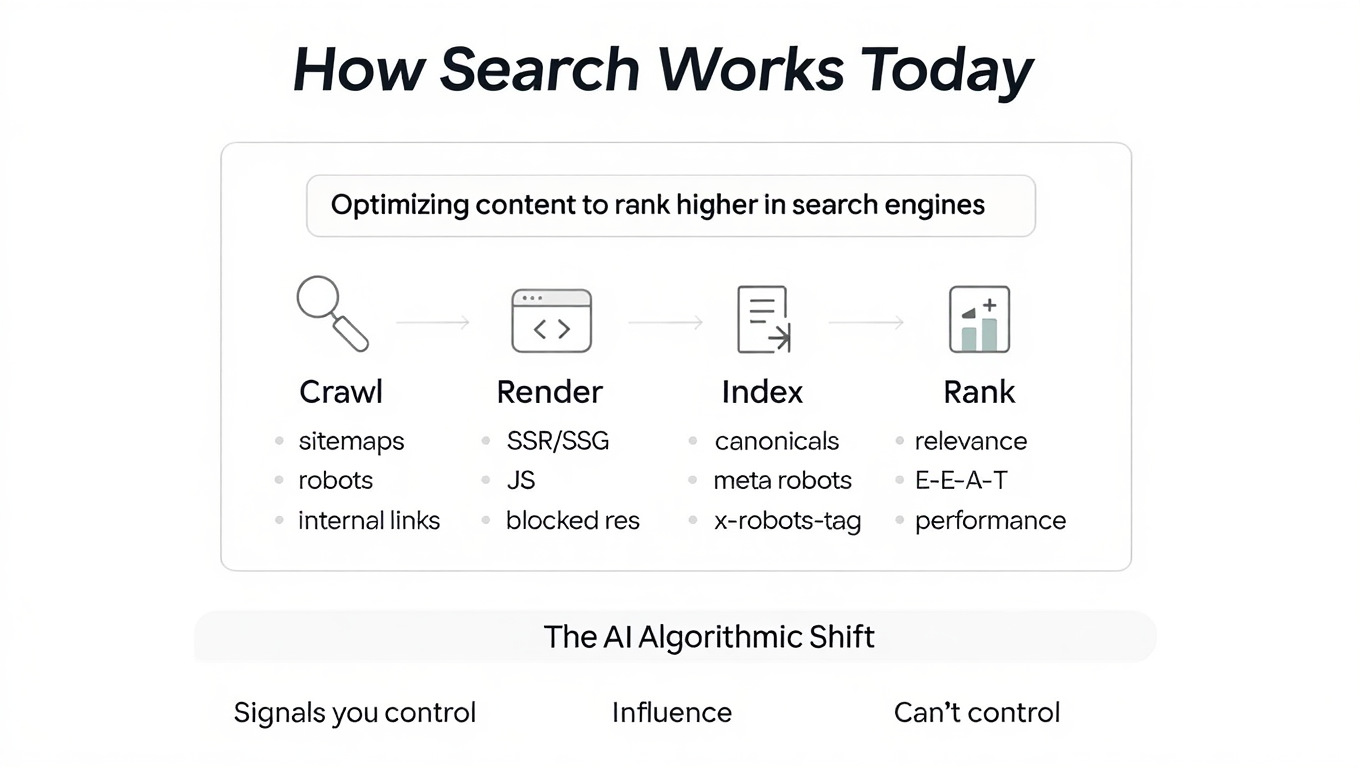
How Search Engines Work Today (Crawl → Render → Index → Rank)
Before we dive deeper in SEO, it’s important to know how search engines actually discover, process, and display content. Every time you publish a new page, it enters a system that moves through three key stages — Crawl, Index, and Rank.
When you understand how this process works, you can fix what's slowing your site—whether it’s how pages are found, loaded, or ranked.
Crawl & Discovery — What Gets Seen
Use XML sitemaps, robust internal links, and verified external links.
Keep servers stable; avoid crawl errors and 5xx responses.
Manage crawl budget → block duplicates, feed valuable URLs.
Render & Index — What Gets Stored
Use SSR/SSG for key pages; avoid heavy client-side JS.
Check canonical tags, robots meta, and x-robots headers.
Return proper 404/410 for dead URLs; avoid soft 404s.
Rank & Serve — What Shows Up
Ranking signals: relevance, E-E-A-T, performance, freshness.
SERPs blend blue links, snippets, packs, discussions, and AI panels.
Structured data improves visibility in rich results.
“Google’s E-E-A-T framework now emphasizes real-world experience alongside authority and trust (Southern, 2023, Search Engine Journal).”
SEO ensures your content aligns with these signals — helping it surface when users ask related questions or explore a topic through AI Overviews. But even with perfect crawling, indexing, and ranking, your content can only succeed if it matches what people are actually searching for.
This underlying motivation is called search intent, and mastering it is what separates average SEO from exceptional SEO.
Search Intent: Why Pages Win (or Don’t)
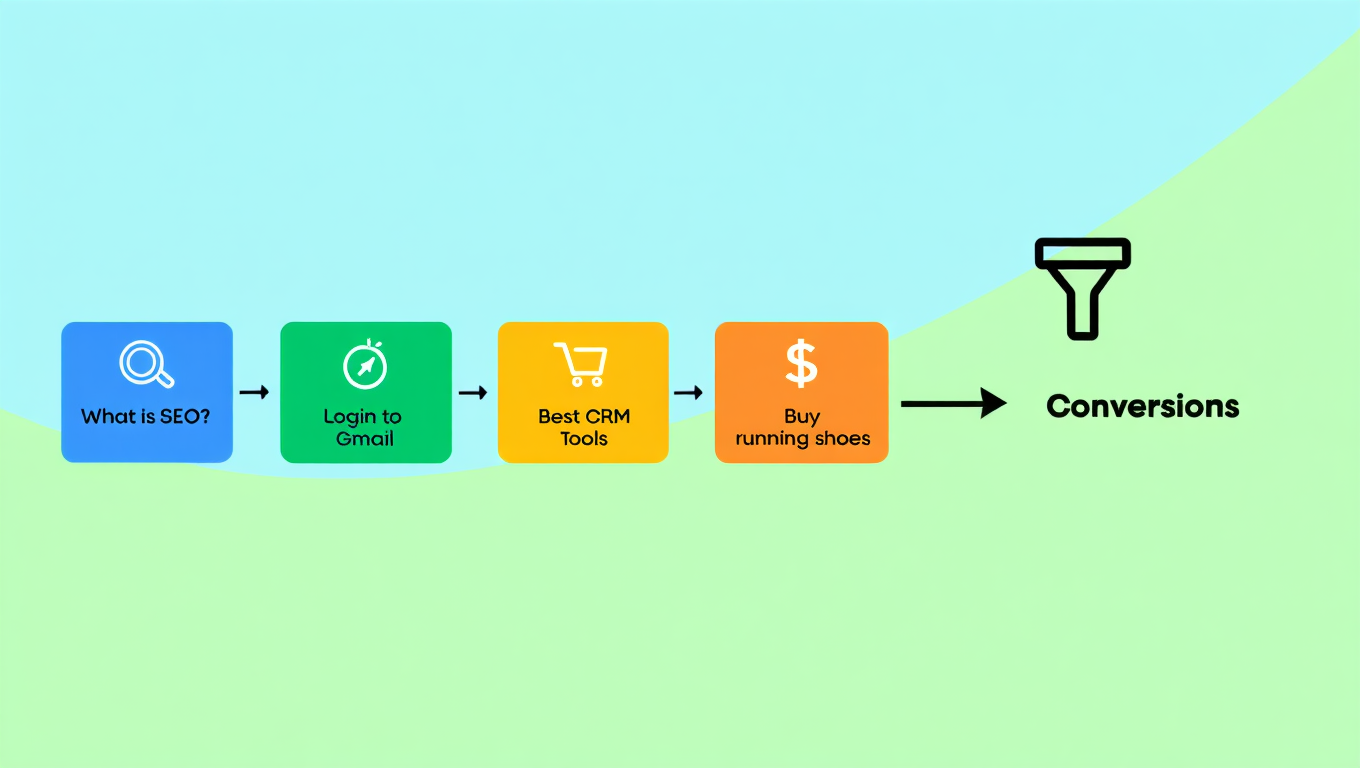
Since 2021, Google’s MUM (Multitask Unified Model) and SGE (Search Generative Experience) have changed how search works. Google now uses AI to understand what people really mean when they search, not just the search terms they type.
It now focuses on user intent-what people actually want to do, not just the words they type. Every search has a purpose: to learn, compare, buy, or find something new. When your page gives the right answer quickly, people stay and take action. But if it misses their goal, it won’t rank well.
As people start searching in new ways — mixing questions like “what is,” “near me,” and “buy” — your SEO plan needs to match all parts of their intent. That means organizing topics clearly, adding the correct schema, and giving enough detail to answer every type of search.
Examples:
“What is CRM software?” → Informational blog with definition + benefits.
“HubSpot vs Zoho” → Commercial comparison with pricing table.
“Buy SEO audit service” → Transactional landing page with CTA.
Don't split one intent into many thin pages (“Top 10 CRMs” + “Best CRM Tools” + “Top CRM Platforms”). Merge and strengthen them instead.
Intent → Page Pattern → Success Metric
Intent | Page Type | Pattern | Schema | KPI |
Informational | Blog / Guide | Definition → Steps → Table | FAQ / Article | Time on Page |
Commercial | Comparison | Features + CTA | Product / Review | CTR / Leads |
Transactional | Landing Page | Offer + Form | Offer | Conversions |
Navigational | Brand Page | Structured Nav | Breadcrumb | Bounce Rate |
Factors Affecting SEO Performance
Several key elements influence how well your website ranks and performs in search results.
The Role of Content
Content optimization means making your words, images, and layout easy to read and understand (Sutter, 2016). Search engines look for content that is original, unique, and trustworthy. Good content shows the actual experience, answers questions clearly, and links to reliable sources.
Why Quality Beats Quantity
Algorithms like Helpful Content (2022–2023) penalize unoriginal or thin text.
Depth means solving user questions fully, not adding fluff.
Include visual proof: screenshots, charts, or short data points.
Always cite reputable sources or experts—Google rewards verified accuracy.
AI-Assisted Writing — Use It Wisely. AI tools speed research and draft building, but unedited AI text often sounds generic. Use AI for:
Topic clustering & outline generation.
Keyword variant discovery.
Data extraction and summaries.
Then add human touch: examples, tone, and emotional context. AI should assist, not replace expertise.
Content Optimization Checklist:
Element | Why It Matters | Tool / Method | Frequency |
Title & Meta | Drive CTR | GSC | Each update |
Headings | Clarity | On-page audit | Per post |
Internal Links | Context | Screaming Frog | Quarterly |
Visual Proof | Originality | Screenshots / Data | Always |
Citations | E-E-A-T | Source links | Always |
Refresh | Freshness | GSC trends | Quarterly |
Mobile, UX, and Accessibility in SEO
SEO success depends on usability. Google now looks at how your site works on mobile phones, how fast it loads, and how easy it is for everyone to use (Schwartz, 2023, Search Engine Land). A fast, simple, and friendly design builds trust — and helps more visitors turn into customers.
UX Signals that Influence Rankings
CTR (Click-through Rate): reflects title/meta clarity.
Stay Time: Longer visits show content value.
Bounce Rate: High bounces hint at misaligned intent.
Conversions: Final proof that page design supports purpose.
Mobile Optimization Rules (2026 Standard)
Responsive design for all viewports.
Tap-friendly buttons (≥48px).
Font ≥16px readable on dark mode.
Test with Google's Mobile-Friendly tool.
Accessibility and Media Optimization
Accessibility means making your site easy for everyone — including people who use screen readers or keyboards to browse.
Add alt text and ARIA labels, keep navigation simple, and make sure your site reads well aloud.
This also ties into Image SEO and Video SEO.
Use clear file names and short captions that describe each picture or video.
Add structured data and transcripts so Google understands your visuals, too.
Here’s How It Worked: When a hotel booking site made its mobile pages easier to use and added ARIA tags for screen readers, the pages loaded 28% faster. Some people left early, and bookings went up by 19%.
SEO vs SEM
When it comes to driving traffic and growing your online visibility, two terms dominate the conversation — SEO (Search Engine Optimization) and SEM (Search Engine Marketing). While they share the same goal — to get your business noticed on search engines — the approach, cost, and timeline for results are completely different.
SEO is organic. It focuses on improving your website so it naturally appears in search results — no ad spend required. You earn visibility through relevance, quality content, and authority.
SEM is a broader term that encompasses SEO, paid search advertising, keyword bidding, and the optimization of ad copy & landing pages. It’s the entire strategy of improving your visibility on search engines — whether through organic ranking or paid ads.
SEO vs PPC
While SEM is the umbrella strategy, & PPC (Pay-Per-Click) is its subset based on paid advertising model. Comparing SEO and PPC helps businesses decide how to balance short-term wins with long-term growth.
PPC delivers instant visibility. You can appear at the top of Google today — but only while you’re paying for clicks. It’s perfect for limited-time offers, launches, or testing new markets.
SEO takes time but pays off for years. Instead of buying visibility, you earn it through relevant content, technical optimization, and backlinks. Once established, it continues driving traffic without ongoing ad costs.
Quick Breakdown
Factor | SEO | PPC |
Timeline | Gradual results (3–6 months) | Immediate visibility |
Cost Model | No per-click charge | Pay per click or impression |
ROI Curve | Grows exponentially over time | Declines once ads stop |
User Trust | Higher (organic credibility) | Lower (users recognize ads) |
Best For | Sustainable traffic & authority | Quick conversions or experiments |
The winning formula to rank on search engines: Use PPC to learn which keywords convert best — then use SEO to rank for them long-term. PPC feeds fast data; SEO builds lasting results.
Measuring SEO Success
A well-planned SEO report tells a clear story about growth, not just numbers. Focus on how people find you, what they do on your site, and how it helps you earn more. When business owners see real sales and savings, they see SEO as a smart way to grow, not just an expense.
Build a Simple Customer Journey (GA4 + GSC)
Flow: Acquisition → Content → Conversions
Acquisition: non-brand clicks, impressions, CTR.
Content: top pages, engagement time, bounce rate.
Conversions: assisted sales, demo requests, and ROI.
KPI Checklist:
Metric | Where to Find | Why It Matters | Alert Threshold |
Non-Brand Clicks | GSC | True organic reach | −10 % WoW |
Share of Voice | Rank Tracker | Competitor gap | > 10 % |
Conversion Rate | GA4 | Efficiency | < 2 % |
INP / LCP / CLS | PSI / CrUX | UX Health | > 200 / 2.5 / 0.1 |
Backlink Authority | Ahrefs | Trust | Drop > 5 pts |
Revenue from SEO | CRM | ROI | MoM drop |
Building a Future-Proof SEO Strategy
Future-proof SEO means always staying curious and ready for change. Google updates come and go, but the basics stay the same — know what people need, write real and helpful content, and keep your site quick and easy to use. In short, when you build your SEO plan using real data and smart insights, every Google update becomes a chance to grow — not a FOMO.
Set Measurable, Intent-Led Goals
Map every keyword to a business goal (awareness → consideration → conversion).
Define SMART KPIs: clicks, assisted conversions, leads, or revenue, not just rankings.
Create a content lifecycle: draft → publish → review quarterly → refresh yearly.
Map Complete User Journeys
Use search queries as entry points, not endpoints.
Connect blog → comparison → product → checkout → review.
Add retargeting or email flows to re-engage organic visitors who didn't convert.
Integrate SEO With Content & Paid
SEO informs topics; content marketing humanizes them.
Paid campaigns confirm new messaging before scaling organically.
PR and SEO teams should share calendars, as earned media increases both visibility and trust.
Adapt When Algorithms Change
Don't chase scores—focus on consistency.
Track every core update's arrival time and correlate with traffic changes.
When drops happen:
Check eligibility (indexing, robots).
Review content depth and originality.
Audit UX & Core Web Vitals.
Google algorithm updates can change how your site ranks, so your SEO strategy should focus on long-term quality, not quick wins (Martin, 2026, Search Engine Journal).
Expert Takeaway:
SEO in 2026 is about more than just achieving higher ranks. It's about building trust, being seen, and growing with every change. Experts at HatchTechs UAE say, “When you plan with real data, know your audience, and write with care, every Google update becomes a chance to grow — not something to fear.”
Conclusion
SEO in 2026 isn’t just about getting to the top of Google. It’s about being real, accurate, and truly helpful. Search keeps changing, but one thing remains the same — people want simple and honest answers that make sense.
AI can generate quick summaries, but it lacks the ability to think or feel like humans do. Modern SEO mixes smart tools with real human experience — fast-loading pages, clear answers, and useful stories.
The best results come when you earn trust, not when you try to trick the system. If you focus on helping people instead of chasing keywords, your site will grow and keep loyal visitors.
As search gets smarter, make your website feel more human. Keep it clean, easy to read, and reliable. SEO today isn't about beating Google — it's about understanding people and helping them find real value.