
How to Create an Effective SEO Strategy in 2026
Blog
July 20, 2026
83 views
Super Admin
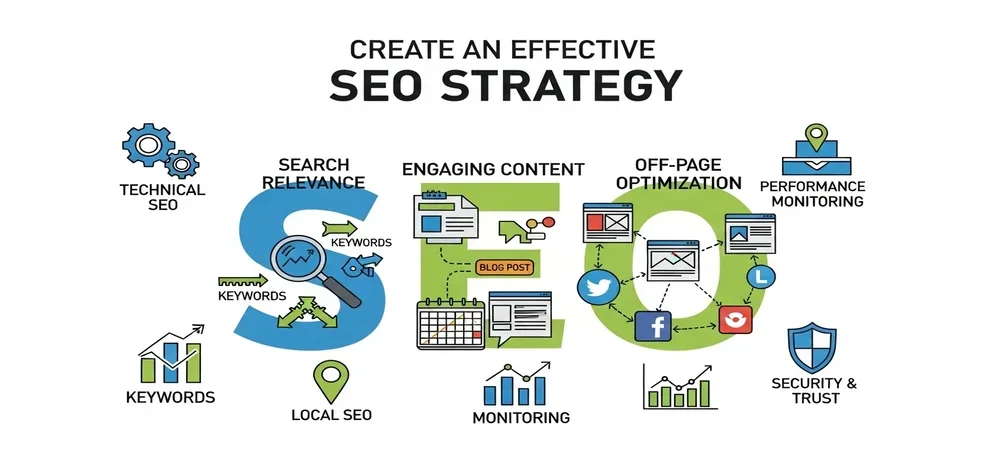
Building a successful SEO strategy in 2026 requires more than just targeting keywords—it demands a focus on search intent, high-quality content, technical optimization, user experience, and AI-driven search trends. By combining on-page, off-page, and technical SEO with data-driven insights, businesses can improve rankings, attract qualified traffic, and achieve sustainable growth. This guide walks you through the essential steps to create an effective SEO strategy that delivers long-term results in today's evolving search landscape.
SEO in 2026 is not merely about ranking higher — it's about staying seen, trusted, and credible in a world shaped by AI.
Search engines like Google now use smart tools such as SGE and MUM, which understand meaning and intent better than ever before.
That means old keyword tricks no longer work. What matters now is helpful content, clear answers, and genuine value.
It is not only about keywords. The way people search is different, too — they talk to AI, use voice, and expect personal results. To keep up, businesses need to mix human creativity with AI-powered tools to stay visible and connect with real people.
This guide shows you how to build a data-backed SEO strategy that fits new search behaviors and turns visibility into real engagement and conversions.
Key Takeaways:
SEO is now intent-driven and AI-assisted. Algorithms interpret meaning, not just words.
E-E-A-T (Experience, Expertise, Authoritativeness, Trustworthiness) defines visibility.
Combine automation tools with human insights for balance.
AEO (Answer Engine Optimization) prepares your brand for AI-generated results.
UX and CRO improvements now directly influence SEO performance.
Predictive SEO enables you to anticipate future search trends before competitors do.
Continuous optimization keeps your rankings strong amid frequent algorithm updates.
What Is an SEO Strategy (in 2026)?
An SEO strategy in 2026 aligns automation, authority, and intent to satisfy both human readers and AI systems.
Today's SEO strategists don't just chase rankings — they design ecosystems that engage and convert. A proper strategy defines how your website communicates value, earns trust, and adapts to changing user search behavior.
It's no longer about volume; it's about understanding what users need and when they need it. An effective SEO strategy maps your brand to that moment.
Why SEO Strategy Matters More Than Ever in 2026
A data-backed SEO strategy ensures brand visibility, trust, and revenue growth in AI-powered search landscapes.
Search engines have evolved into “answer engines.” They now interpret intent, pull insights, and generate meaningful overviews for users. Without a well-defined plan, your brand’s content can get lost in AI summaries.
That is why a competitive SEO strategy in 2026 must bridge three key pillars: user need, AI understanding, and brand expertise (Google Search Central, 2025). Businesses that take a structured, insight-driven approach outperform reactive ones by up to 45% in organic visibility (SEMrush, 2025).
Smart SEO = Consistent Traffic + Brand Trust + Conversions.
Core Components of an Effective SEO Strategy in 2026
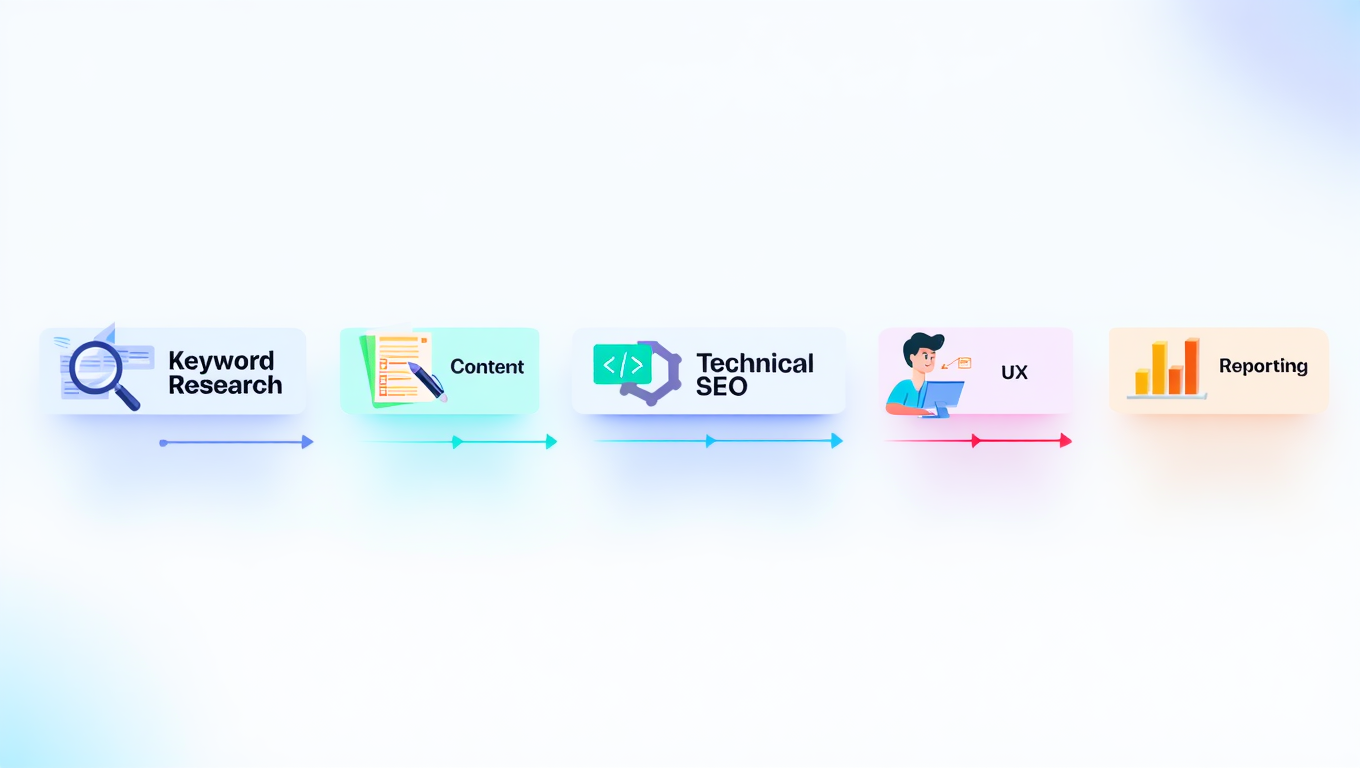
A future-proof SEO strategy integrates technical excellence, content authority, backlinks, and automation under one unified plan.
1. Intent-Based Keyword Research
Keyword research isn't about volume anymore — it’s about understanding questions and context.
Use conversational and long-tail queries that match real searches like:
“Best SEO tools for small businesses in UAE”
“How to increase organic traffic without ads”
Tools such as Google Trends, Ahrefs, and Rankify help you cluster keywords by user intent (informational, transactional, navigational).
2. Technical SEO Strategy & Site Architecture
A solid technical SEO strategy ensures search engines can easily understand and index your site.
Technical SEO focuses on:
Core Web Vitals: Speed, responsiveness, visual stability.
Crawl Depth: Important pages within three clicks.
Schema Markup: Structured data for AI and SGE understanding.
Mobile Optimization: Fast, responsive layouts for on-the-go users.
3. Content Strategy: Value Over Volume
Quality beats quantity. In 2026, content that demonstrates expertise and experience earns trust faster than keyword-heavy pages.
For instance, HatchTechs UAE regularly updates case studies showing real ROI results. It's a strategy that builds both authority and relevance.
Always focus on:
Solving a user problem.
Offering data-backed insights.
Using simple, human language.
4. On-Page Optimization for SGE
Your on-page SEO now feeds AI engines.
In order to adapt:
Include FAQ schemas and summary boxes.
Write concise definitions under each heading.
Use structured H-tags and rich metadata.
This helps Google's AI select your content for overviews, not just listings.
5. Off-Page SEO & Backlinks Strategy
Backlinks SEO strategy in 2026 is about earning, not trading.
High-quality links from reputable, relevant sources improve topical authority.
Tactics include:
Digital PR collaborations.
Guest features on industry blogs.
Citing real studies and data that others want to reference.
Here's a simple tip: One link from an authoritative domain beats 20 low-quality mentions.
6. Local & Mobile SEO
For regional businesses, location and accuracy matter most.
Optimize your Google Business Profile.
Use local schema and geo keywords (e.g., “SEO agencies in Dubai”).
Promote reviews — they’re a primary E-E-A-T signal.
Google's mobile-first indexing is still the default — it means the mobile version of your site is what Google uses to rank pages.
“HatchTechs UAE clients see up to 35% more traffic through well-optimized local listings.”
7. AI Tools & Automation in SEO
Automation accelerates growth, but human supervision keeps it authentic.
Smart platforms like Gumloop, Clearscope, and MarketMuse help find keywords, check content quality, and track results. They save time by handling data and reports. But people still bring the ideas, tone, and understanding that make content connect.
The best results come when AI does the work and humans add the meaning.
8. SEO + UX Integration
User experience is one of the core ranking factors.
Google now measures how users interact — not just if they visit.
Fast load = higher engagement.
Interactive design = longer stay time.
Accessibility = inclusivity (and compliance).
Optimizing UX directly fuels your SEO growth strategy.
9. Answer Engine Optimization (AEO) & SGE Readiness
AEO is the next big step in how search engines find and share answers.
It's about positioning your brand (content) as the answer in AI overviews.
How to prepare:
Write in Q&A format.
Keep answers under 50 words.
Use schema for FAQs and HowTos.
Structure every section for snippet readiness.
“According to a 2025 Semrush study (Semrush, 2025), AI Overviews appeared in 13.14% of all Google searches by March — double the rate from January. This sharp rise shows how fast AI-driven summaries are reshaping visibility and user behavior.”
10. Semantic SEO & Entity Optimization
Search engines now read the clear concepts, not keywords.
When your pages connect around one main topic, it helps search engines see the full picture. Start by choosing your main idea, then link your related pages together so readers can move easily between them. This makes your site easier to explore and shows that your content is trustworthy.
Example: Connecting pages about “SEO Strategy,” “Backlinks,” and “Technical SEO” helps search engines understand they all belong to the same topic.
How to Build an SEO Strategy Step-by-Step (Action Plan for 2026)
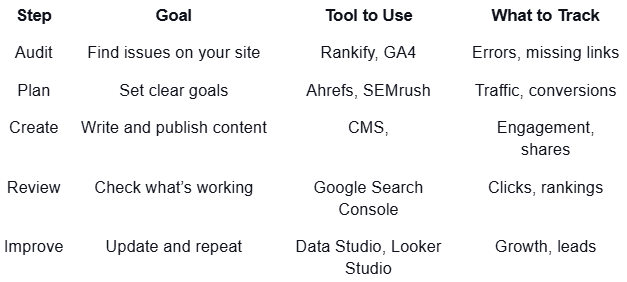
An effective SEO action plan defines goals, maps intent, optimizes content, and tracks results through AI analytics.
Step 1: Audit Current Performance
Start by checking your website’s current performance. Look for broken links, slow pages, or missing details. Tools like Rankify or GA4 can help you identify minor problems before they escalate into bigger issues.
Step 2: Define Clear Goals (Traffic, Conversions, Revenue)
Decide what you really want from SEO—more visitors, more leads, or more sales. Set easy-to-measure goals, such as the number of people visiting or making a purchase each month.
Step 3: Build Intent-Focused Keyword Map
Find out what people are searching for. Group similar words together and write pages that answer their real questions. When your content matches what people need, Google rewards you with better visibility.
Step 4: Align Content Pillars with Buyer Journey
Think about your readers' journey. Some are learning, some are comparing, and some are ready to buy. Create content for each stage so everyone can easily find what they’re looking for.
Step 5: Optimize for AI & Voice Search
People now use AI-assistants on phones and smart devices for answers (Statista, 2025, Jan). Use natural questions like "how,” "where,” or “why” in your content. This helps AI tools understand and share your answers faster.
Step 6: Automate Reporting and Track KPIs
Use smart tools to check your progress each month automatically. Dashboards show what’s working and what needs attention, saving you time and keeping you focused.
Step 7: Iterate and Update Quarterly
SEO never stops changing. Every few months, refresh your content, update your keywords, and fix minor issues. These regular updates help your site stay strong and easy to find leads.
Table: SEO Action Checklist 2026
Common Mistakes to Avoid in 2026
Avoid over-reliance on AI tools, the use of low-quality backlinks, or ignoring what users really want. These mistakes can weaken your SEO strategy and hurt your rankings.
Top Mistakes to Watch for:
Over-relying on AI-generated content without human editing.
Ignoring user intent and focusing only on keywords can lead to poor results.
Neglecting link quality and E-E-A-T signals.
Failing to update or re-optimize old content after algorithm updates.
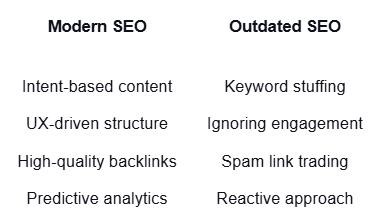
Modern SEO vs. Outdated SEO: How are They Different
Future of SEO Beyond 2026
The future of SEO will utilize smart data, clear answers, and visual search to provide every person with a faster and more personalized search experience.
Predictive SEO & AI Personalization
Smart tools will soon guess what people want before they even search. This helps brands write the right content early and stay ahead of trends.
Rise of AEO (Answer Engine Optimization)
Instead of waiting for clicks, brands will focus on giving clear answers. AI assistants and smart devices will read these answers to users right away.
“After Google’s March Core Update, AI Overviews increased by 116% — showing how fast search is becoming driven by AI summaries (Google Search Central, 2025).”
Voice, Visual & Zero-Click Search
People will talk to their phones or use pictures to search (Ahrefs, 2025). Answers will show instantly—no clicks, just quick results on screen or through voice.
Multi-Search & Multimodal SEO
Search will combine text, images, and audio. Tools like Google Lens and AR enable people to find information using images or even their camera.
Measuring SEO Success in 2026
SEO growth in 2026 means showing up in AI results, keeping visitors engaged, and turning them into real customers.
Smart SEO goes beyond rankings. It’s about being useful, clear, and easy to reach. By tracking the right metrics, you can learn what your audience enjoys and how to enhance their experience.
Core KPIs
These basic numbers show how effectively your SEO is doing every day.
Organic Traffic: Counts how many people find your site through Google. More visits mean your pages are reaching the right audience.
Click-Through Rate (CTR): Shows how many people click your link in search results. A catchy title and clear description help increase it.
Stay Time: Tells how long visitors stay on your page. The longer the visitors are on your website, the higher their chances of conversion.
Bounce Rate: Shows if people leave quickly after landing. A lower rate means they’re finding what they need.
Advanced Metrics
These elements help you understand how well your brand performs in AI-driven search.
AI Snippet Visibility: Measures how often your content appears in AI answers or Google's overviews.
Entity Strength: Shows how clearly Google recognizes your brand or topic. The strength of links and steady content builds this.
SGE Impressions: Counts how often Google's AI uses your page to answer a question.
Tools to Track Results
Google Search Console (AI Insights): Tracks keywords, clicks, and AI visibility.
Rankify: From HatchTechs UAE — gives easy visuals for backlinks, keywords, and page growth.
GA4: Connects your organic traffic with conversions and sales.
Pro Tip: Review your reports monthly and refresh your SEO plan quarterly. Minor, regular updates keep performance high.
Conclusion:
In 2026, the best SEO strategies mix data, human expertise, and continuous improvement to build lasting trust online.
SEO isn't only about rankings anymore — it's about connection. When your content helps people, it gives search engines a clear trust signal. As we explore the evolving landscape of SEO, simple yet effective lessons can help brands grow, maintain visibility, and foster lasting relationships with their audience.
Key Lessons for Modern SEO:
Focus on people, not algorithms.
Write content that answers real questions in simple, honest ways.
Use data to stay smart.
Regularly check your numbers to see what’s working and what’s not.
Blend AI with human creativity.
Let tools do the heavy work, but keep your brand voice real and personal.
Focus on quality backlinks and UX.
Trusted links and smooth browsing build both authority and confidence.
Be consistent and adaptable.
Update your pages regularly and stay ready for new SEO trends.
When SEO is constantly evolving, it can be challenging for teams to keep up. That's why at HatchTechs UAE, we built Rankify — a simple tool that shows what's working, helps fix problems quickly, and gives smart tips to stay ahead.